
India's wholesale price inflation (WPI) increased to 9.87 per cent in June, up from 9.68 per cent in May, primarily due to significant price increases in non-food and food products, with food inflation alone rising to 5.49 per cent.

Flows from overseas Indians into Non-Resident Indian (NRI) deposit schemes have fallen by 24.17 per cent to approximately $11.04 billion between April 2025 and February 2026, down from $14.56 billion in the previous year, according to Reserve Bank of India (RBI) data.

The number of persons employed in 27 sectors, including agriculture, trade and financial services, increased by 3.31 per cent year-on-year to 59.66 crore in 2022-23, according to data published by the RBI on Monday. During 2021-22, the employment in these 27 sectors stood at 57.75 crore.

The Indian rupee experienced a significant surge against the US dollar following the Reserve Bank of India's measures to restrict banks from onshore forward markets. Despite this, the rupee remains under pressure from foreign capital outflows, a strong dollar, and rising crude oil prices.

The Indian stock market is poised for a volatile week, influenced by the Reserve Bank of India's monetary policy decision, crucial global macroeconomic data, and the escalating geopolitical tensions in West Asia, according to market analysts.

The Reserve Bank of India (RBI) has introduced its 'Payments Vision 2028' document, outlining initiatives to enhance digital payment security, introduce electronic cheques, and expand regulatory oversight to include e-commerce entities.

India's foreign exchange reserves decreased by $711 million to $681.61 billion for the week ending June 5, primarily driven by a significant reduction in foreign currency assets, according to the Reserve Bank of India (RBI).
The Indian rupee rebounded against the US dollar following intervention by the Reserve Bank of India, amidst ongoing concerns about foreign capital outflows, rising crude oil prices, and geopolitical instability.

Foreign Portfolio Investors (FPIs) withdrew Rs 49,340 crore (USD 5.16 billion) from Indian equities in June, driven by global risk aversion, a preference for developed markets, soaring US bond yields, and stretched domestic valuations, bringing total withdrawals to Rs 2.7 lakh crore so far in 2026.

The Federation of Indian Export Organisations (FIEO) has appealed to the Reserve Bank of India (RBI) for liquidity support to Indian exporters, citing a significant increase in freight costs and extended payment cycles due to the ongoing West Asia conflict.

The Indian rupee weakened against the US dollar due to geopolitical tensions surrounding the Strait of Hormuz and ahead of the Reserve Bank of India's monetary policy review.

Commercial banks in India recorded their highest credit growth in two years, accelerating to 18.6 per cent year-on-year by June 27, while also mobilising nearly 7 trillion in deposits, marking the third-highest fortnightly deposit growth in 29 years.

The Reserve Bank of India (RBI) Governor Sanjay Malhotra is now confronting the classic growth-inflation tradeoff, a situation exacerbated by the West Asia war, which threatens to end the 'goldilocks period' of low inflation and robust growth.

...exceeding their 49,340 crore equity selloff.

India's wholesale price index (WPI) inflation surged to 9.68 per cent in May, up from 8.26 per cent in April, primarily due to significant increases in the prices of fuel and power, manufactured goods, and food items.

Indian companies' overseas expansion plans are holding strong despite geopolitical tensions in West Asia, driven by structural factors like supply-chain diversification, free trade agreements, and market expansion, according to Ajay Sharma, managing director and head of banking at HSBC India.

To meet liquidity pressure because of advance tax outflows this month, the Reserve Bank of India (RBI) has adopted a measured approach with its latest announcement of open-market operations (OMOs), worth Rs 1 trillion.

The Asian Development Bank (ADB) has revised down India's GDP growth forecast for fiscal year 2026-27 (FY27) to 6.6 per cent from an earlier 6.9 per cent, primarily attributing the change to elevated energy prices stemming from the Middle East conflict. Despite this moderation, India is still expected to remain the world's fastest-growing major economy.

Unified Payments Interface (UPI) transactions moderated slightly in June from a record high in May, reaching Rs 28.9 lakh crore. Despite a month-on-month decrease in volume, the daily average transactions hit a new high, indicating UPI's strong adoption for low-value payments. The platform also demonstrated significant annual growth and expanding international presence.

India's foreign exchange reserves have surged to an all-time high, reaching USD 728.494 billion, according to the Reserve Bank of India. This increase is attributed to a rise in foreign currency assets and gold reserves.

India's forex reserves decreased by $2.119 billion to $723.608 billion during the week ended February 20, according to the RBI.

India's foreign exchange reserves increased by USD 938 million to USD 682.321 billion during the week ended May 28, according to the Reserve Bank of India, following a previous week's drop.
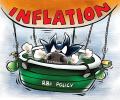
The Indian government has extended the Reserve Bank of India's (RBI) mandate to maintain retail inflation at 4 per cent, with a tolerance band of 2 per cent on either side, for another five years until March 2031.

Analysts predict that developments in West Asia, their impact on crude oil prices, and the trading activity of foreign institutional investors (FIIs) will be crucial factors influencing the Indian stock market this week.
India's foreign exchange reserves saw a significant drop of USD 8.094 billion, settling at USD 688.894 billion for the week ending May 15, as the Reserve Bank of India intervened in the forex market and global events like the Middle East conflict impacted the rupee.

India's economy registered a robust 7.7 per cent growth in the fiscal year 2025-26, an increase from 7.1 per cent in the previous year, with the January-March quarter alone seeing a 7.8 per cent expansion.

Indian stock market benchmarks, Sensex and Nifty, saw gains in early trading, driven by anticipation surrounding the Reserve Bank of India's monetary policy decision, despite mixed global cues and significant FII outflows.

Domestic institutional investors (DIIs), driven by the popularity of mutual funds, have emerged as significant stabilising forces for Indian capital markets amidst global volatility and foreign portfolio investment (FPI) outflows, according to Sebi whole-time member Amarjeet Singh.

From April 1, 2026, the Reserve Bank of India's new authentication directions modernise how every digital payment you make must be verified -- and place the burden of security squarely on your bank, not on you.

India's gross savings rate is projected to be nearly 47 basis points higher in FY25 than previously estimated, following the Securities and Exchange Board of India's (Sebi) revision of the methodology for calculating household savings routed through the securities market.

Foreign Portfolio Investors (FPIs) have withdrawn over Rs 62,853 crore from Indian equities in the first fortnight of June, bringing the total outflows for 2026 to Rs 2.87 lakh crore, surpassing the entire 2025 figure, driven by geopolitical tensions, global economic growth concerns, and a weakening rupee.
UPI transactions in India reached record highs in May, driven by summer travel and the IPL, with transaction value hitting Rs 29.90 lakh crore and volume reaching 23.2 billion.

The RBI will now charge banks different deposit insurance fees based on how risky they are, allowing safer banks to pay less premium.
India's foreign exchange reserves saw a significant drop of USD 7.794 billion, settling at USD 690.693 billion for the week ending May 1, as reported by the RBI, reflecting the impact of global events and central bank interventions.

Reserve Bank Governor Sanjay Malhotra on Friday said the key policy rates will remain at low levels for a long period and may go down even further.

Loans against gold jewellery in India surged by an impressive 128 per cent year-on-year to nearly 4.28 trillion in February 2026, according to the latest Reserve Bank of India (RBI) data, significantly outpacing overall retail loan growth.
Foreign Portfolio Investors (FPIs) have withdrawn nearly Rs 43,000 crore from Indian equities in the first week of June, contributing to a total outflow of Rs 2.67 lakh crore in 2026, driven by a global shift towards technology and AI-linked opportunities and persistent rupee depreciation.
India's foreign exchange reserves saw a significant increase of USD 6.295 billion, reaching USD 696.988 billion for the week ending May 8, as reported by the Reserve Bank of India.

Chief Economic Advisor V Anantha Nageswaran stated that India's economy is projected to return to a 7 per cent-plus growth trajectory by 2027-28 (FY28), or sooner if external conditions improve, despite near-term challenges from the West Asia crisis.

The Indian rupee rebounded 50 paise from its all-time closing low to settle at 96.36 against the US dollar, driven by retreating crude oil prices, signs of easing geopolitical friction, and likely central bank intervention.
